If you're looking at inverters, batteries, or generators, you've probably seen the terms kW and kVA. They look similar, but they mean different things. Understanding this difference is key to choosing the right system for your home or office.
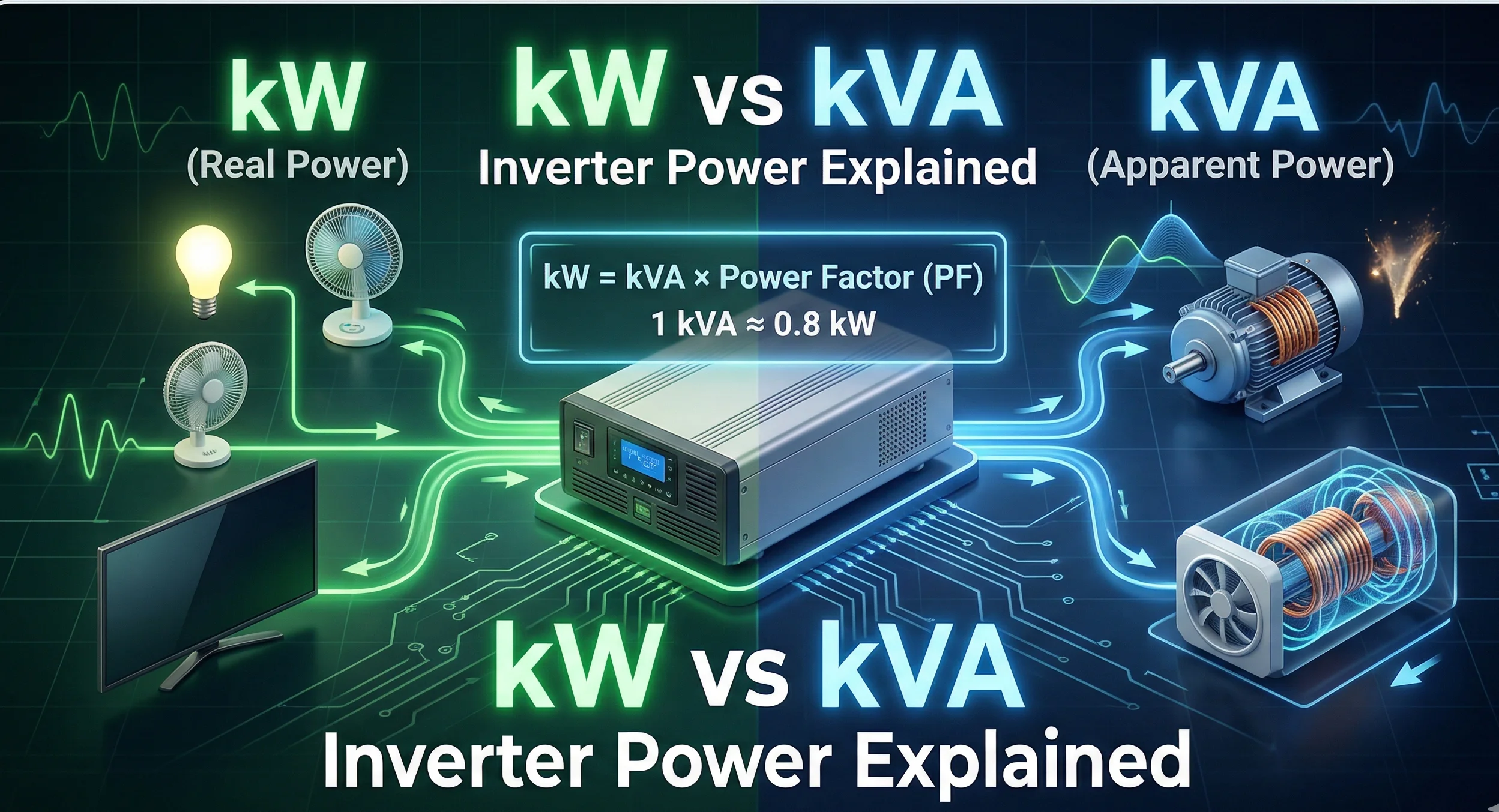
Think of it like this: kW is the power that actually does the work, like running your fridge or charging your phone. kVA is the total power that the inverter has to handle, which includes a little extra "overhead" that some appliances need to start up and run smoothly.
Handy Tools For You
kW vs. kVA: A Simple Breakdown
Here’s the main idea in plain terms:
- kW (Kilowatt): This is the real power. It's the useful power that actually runs your appliances and gets things done. When you pay your electricity bill, you're mostly paying for kW.
- kVA (Kilovolt-Ampere): This is the apparent power. It's the total power flowing in the system, combining the real power (kW) and something called "reactive power." Reactive power is needed by devices like motors, fans, and air conditioners to create their magnetic fields.
The relationship between them is defined by the Power Factor (PF):
kW = kVA × Power Factor
Power Factor = kW / kVA
For most homes, the power factor is between 0.8 and 1.0. A typical assumption is 0.8. This means:
- If an inverter is rated at 1 kVA, its real power output (kW) is roughly 1 kVA × 0.8 = 0.8 kW.
Key Points to Remember
- kW tells you the actual work an appliance will do. It's crucial for figuring out if your inverter can run your specific load.
- kVA tells you the total electrical load on the inverter's components (like its transformer). It helps you understand the system's overall capacity.
- If you ignore the difference, you might buy an inverter that's too small. A 1 kVA inverter cannot support a 1 kW load if the power factor is low—it might overload and shut down.
Why This Matters for Your Inverter
When you buy an inverter, you'll see ratings in both VA (Volt-Ampere) and Watts. The VA rating (like 1100VA) is the kVA rating. The Watt rating is the kW rating.
You need to check the Watt (kW) rating to see if it can handle the total wattage of the devices you want to run. You also need to consider the VA (kVA) rating to ensure the inverter's internal wiring and components can manage the total current, especially when starting motors which draw a high initial current.
For a more detailed look at power calculations and other electrical tools, you can check out our Unit Converter tool.
Frequently Asked Questions
📚 Read Next


Which is more important for my inverter, kW or kVA?
Both are important, but for different reasons. Use the kW rating to make sure the inverter can power your appliances (like a 100W bulb or a 500W fan). Use the kVA rating to ensure the inverter system itself (its wiring and circuits) is built to handle the total electrical demand, especially from devices with motors.
Can a 1 kVA inverter run a 1 kW load?
Not always. It depends on the power factor. If the power factor is 1 (which is ideal but rare), then yes, 1 kVA = 1 kW. But with a typical power factor of 0.8, a 1 kVA inverter can only handle about 0.8 kW of real load. Trying to run a 1 kW load could overload it.
How do I calculate the kVA I need for my home?
First, add up the wattage (in kW) of all essential appliances you want to run on the inverter. Then, divide that total kW by the expected power factor (use 0.8 for a safe estimate). For example, if your total load is 1.6 kW, you'd need at least a 1.6 kW / 0.8 = 2 kVA inverter. Our EMI Calculator can also help you plan the financial aspect of such an investment.
Do all appliances affect the power factor?
No. Devices that simply heat or light up (like bulbs, heaters, toasters) have a power factor close to 1. They mainly use real power (kW). Devices with motors or transformers (like fans, air conditioners, refrigerators) have a lower power factor because they need reactive power, which increases the kVA demand.