Figuring out the right inverter size for your home can feel a bit confusing. It's not just about picking the biggest one; it's about finding the one that matches what you actually use. Let's break it down into simple steps.
How to Figure Out Your Inverter Size
Think of it like this: you're planning a party. You need to know how many guests are coming and how much food they'll eat. For an inverter, your "guests" are your appliances, and the "food" is electricity (measured in watts).
Handy Tools For You
Step 1: List Your Essential Appliances
First, make a list of the things you absolutely need to run during a power cut. This usually includes:
- Lights (LED bulbs, tube lights)
- Fans
- A television
- A Wi-Fi router
- Maybe a refrigerator
Step 2: Check Their Power Rating
Every appliance has a power rating, written in watts (W) or sometimes in amps (A). You can find this on a sticker on the back or side of the appliance, or in its manual.
Here's a rough guide for common items:
- LED Bulb: 7-15 W
- Ceiling Fan: 50-80 W
- Television (LED): 50-150 W
- Wi-Fi Router: 10-20 W
- Refrigerator: 150-300 W (but it cycles on and off)
Step 3: Do the Math
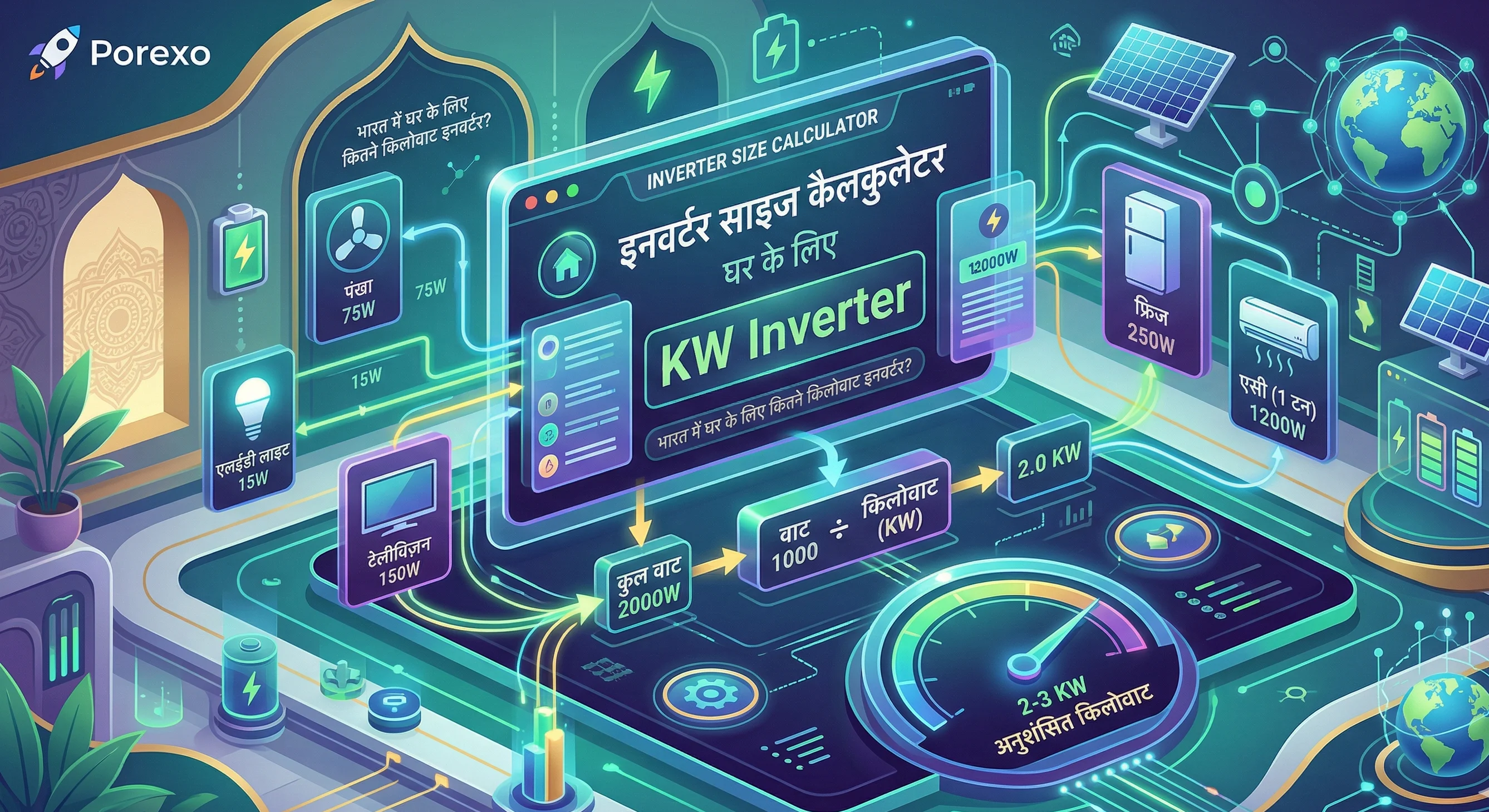
Add up the watts of all the appliances you'll run at the same time. Let's do an example for a typical 2-BHK home:
4 LED Lights (10W each) = 40 W
3 Ceiling Fans (70W each) = 210 W
1 Television (100W) = 100 W
1 Wi-Fi Router (15W) = 15 W
1 Refrigerator (200W) = 200 W
------------------------------
Total Simultaneous Load = 565 W
So, your appliances need about 565 Watts at peak usage.
Step 4: Convert Watts to Kilowatts and Add a Buffer
Inverter capacity is sold in kilowatts (kW) or kilovolt-amperes (kVA). 1 kW = 1000 Watts.
From our example: 565 W = 0.565 kW.
Important: You should never run an inverter at 100% of its capacity. It needs some breathing room to work efficiently and last longer. A good rule is to add a 20-25% buffer.
Required Capacity = Total Load / 0.8 (for 80% usage)
                  = 0.565 kW / 0.8
                  = 0.706 kW
So, you'd need an inverter of at least 0.7 kW or 700 W.
Since inverters come in standard sizes, you would typically go for the next available size, which is a 1 kVA or 1 kW inverter. (Note: For most home purposes, 1 kVA is roughly equal to 0.8 kW, so a 1 kVA inverter can handle about 800 watts of load, which is perfect for our example).
A Quick Reference Guide
Here's a simple table based on common home setups:
- 1-BHK / Small Apartment (Few lights, fans, TV): 850 VA / 1 kVA inverter is usually sufficient.
- 2-3 BHK / Medium Home (Lights, fans, TV, fridge, computer): You'll likely need a 1.5 kVA inverter.
- Large Home / Running an AC: For even a single 1-ton AC, you're looking at a much larger system, like a 2.5 kVA to 3 kVA inverter. Running an AC on backup is a big power draw and needs careful planning.
One More Crucial Thing: The Battery
The inverter is only half the story. The battery (or batteries) determine how long your appliances will run. A bigger battery bank gives you more backup hours. The inverter's job is to handle the power load; the battery provides the energy storage.
Frequently Asked Questions
📚 Read Next
Is a 1.5 kVA inverter too much for a 2-BHK?
Not necessarily. It gives you comfortable headroom. If you plan to add more appliances later or if your power cuts are long, a 1.5 kVA inverter paired with a suitably large battery is a safe and future-proof choice.
Can I run my water pump or microwave on an inverter?
Be very careful. Devices with motors (pumps) or heating elements (microwaves, geysers) have a very high "starting wattage" or surge power—often 3 to 5 times their running wattage. A standard home inverter may not handle this surge and could get damaged. Always check the inverter's surge rating and consult a professional.
What's the difference between kVA and kW?
kVA (kilovolt-ampere) is the "apparent power," which includes all the power the inverter can deliver. kW (kilowatt) is the "real power" that actually runs your appliances. For simplicity, in the Indian market, a 1 kVA inverter is generally considered to support about 800 watts (0.8 kW) of load. The product specifications will clarify this.
Should I install it myself?
It's strongly recommended to get a qualified electrician to do the installation. They will ensure correct wiring, proper earthing, and safe connections to your home's electrical board, preventing any risk of short circuits or fire.
Final Advice
Use the calculation method above to get a good estimate. But for the final decision, especially for larger homes or if you want to run heavy appliances, talk to a trusted electrician or inverter dealer. They can assess your specific wiring and usage pattern to give you the best recommendation.
For more helpful tools on calculations, you can check out our Unit Converter or our general All Tools page for other utilities.