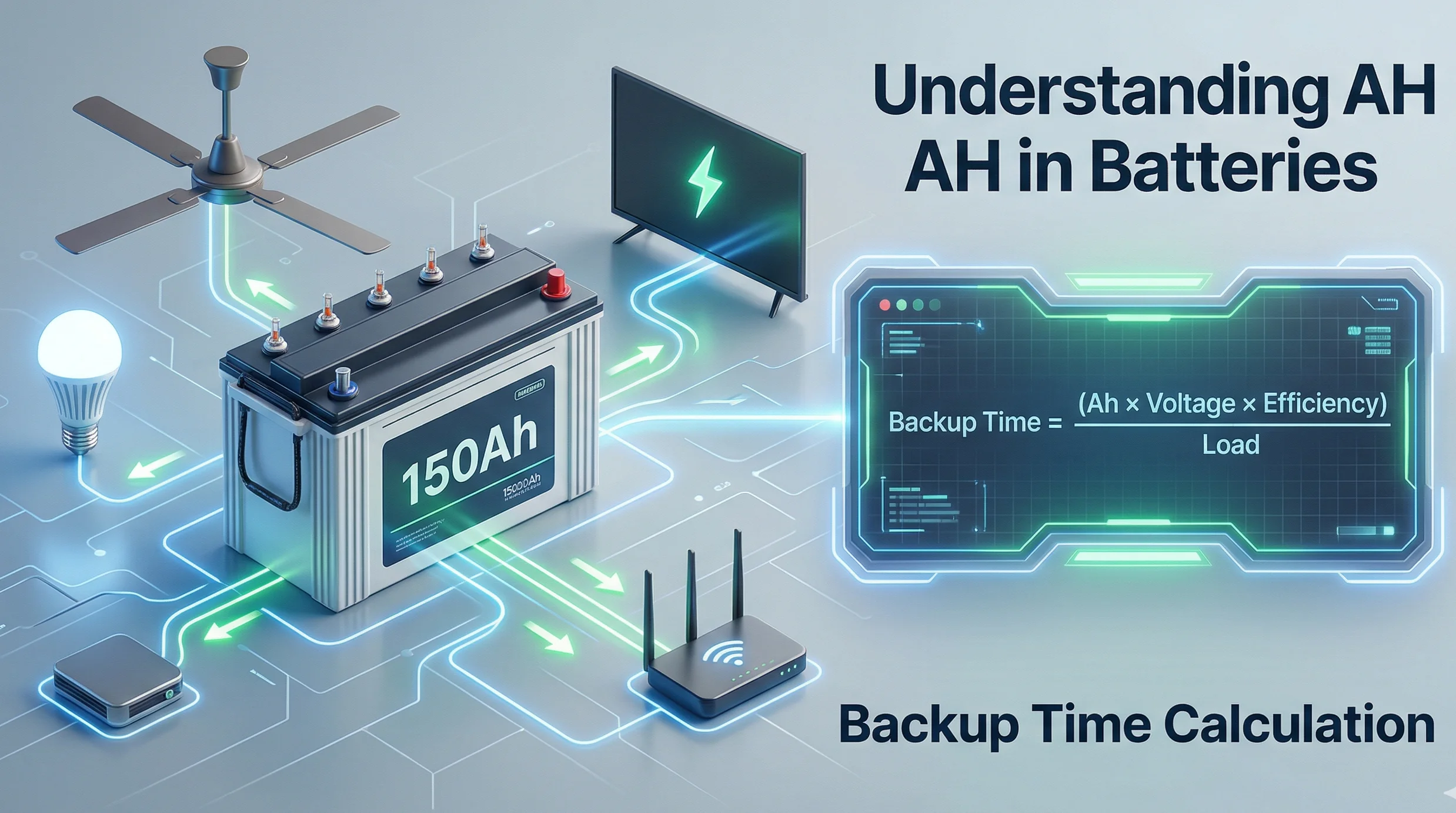
When you're looking at batteries, whether for your inverter, car, or a solar setup, you'll often see a term like "100Ah" on the label. This "Ah" stands for Ampere-Hour. Think of it as the battery's fuel tank. It tells you how much electrical charge the battery can store.
In simple terms, a 100Ah battery can, in theory, supply 1 Ampere of current for 100 hours, or 10 Amperes for 10 hours, before it's completely drained.
Handy Tools For You
How to Figure Out Your Backup Time
You bought a battery to keep the lights on during a power cut. How long will it last? Here's the basic idea:
Backup Time (in hours) = Battery Capacity (Ah) / Load Current (A)
But there's a catch. This is the ideal, textbook calculation. In the real world, batteries aren't 100% efficient, and devices don't always draw a constant power. Here's a more practical way to look at it.
A Step-by-Step Example
Let's say you have a 150Ah battery and you want to run two 40-watt LED bulbs and a 60-watt fan during a power outage.
- Find the total load in Watts: (2 bulbs * 40W) + 60W = 140 Watts.
- Convert Watts to Amps: For a standard 12V battery system, use this formula: Amps = Watts / Volts. So, 140W / 12V = ~11.67 Amps.
- Apply the formula: 150Ah / 11.67A = ~12.85 hours.
This calculation gives you a theoretical maximum. In reality, you should account for efficiency losses (usually around 20-30%) and avoid fully draining the battery to prolong its life. A safer, real-world estimate would be:
Practical Backup Time = (Battery Ah * Battery Voltage * 0.8) / Total Load in Watts
= (150Ah * 12V * 0.8) / 140W
= (1440 Watt-hours) / 140W
= ~10.3 hours
So, with a 150Ah battery, you can realistically expect to run those appliances for about 10 hours.
Key Things to Remember
- Ah is the Capacity: A higher Ah rating (like 200Ah vs. 100Ah) means the battery can power your devices for a longer time.
- Voltage Matters: Always check your battery's voltage (e.g., 12V, 24V) when doing calculations. The formula changes if you're connecting batteries in series.
- Efficiency is Key: No battery delivers 100% of its rated capacity. Factor in a 20-30% buffer for inverter losses and battery health.
- Don't Drain Completely: Regularly draining a battery to 0% drastically shortens its lifespan. It's better to use only 50-70% of its capacity per cycle.
If you need to make quick calculations for different scenarios, tools like our Unit Converter can be handy for converting between units, and for planning other projects, you might find our Compound Interest Calculator useful for financial planning related to your energy setup.
Frequently Asked Questions
📚 Read Next

Is a higher Ah battery always better?
Not necessarily. A higher Ah battery will give you longer backup, but it's also larger, heavier, and more expensive. You should choose a capacity that matches your typical power usage during an outage.
Can I connect two 100Ah batteries to get 200Ah?
Yes, but how you connect them matters. Connecting them in parallel (positive to positive, negative to negative) keeps the voltage the same (e.g., 12V) but adds the capacity, giving you 200Ah. Connecting them in series adds the voltage (becoming 24V) but the capacity stays at 100Ah.
Why does my backup time seem shorter than calculated?
This is very common. The calculated time is a best-case scenario. Real-world factors like an aging battery, high temperature, inefficient inverter, and the fact that most batteries shouldn't be drained below 50% for longevity all reduce the actual backup time.
How can I increase my inverter's backup time?
You have two main options: 1) Increase capacity by adding more batteries or using a higher Ah battery. 2) Reduce the load by being mindful of what appliances you run during a power cut—maybe turn off the TV and keep only the essentials like lights and fans on.