If you're setting up a backup power system at home or just trying to understand how your inverter and battery work, you've probably come across the term "Ampere" or "Amp." It sounds technical, but it's a simple idea once you break it down. Let's talk about what it means for your battery and inverter.
What is an Ampere?
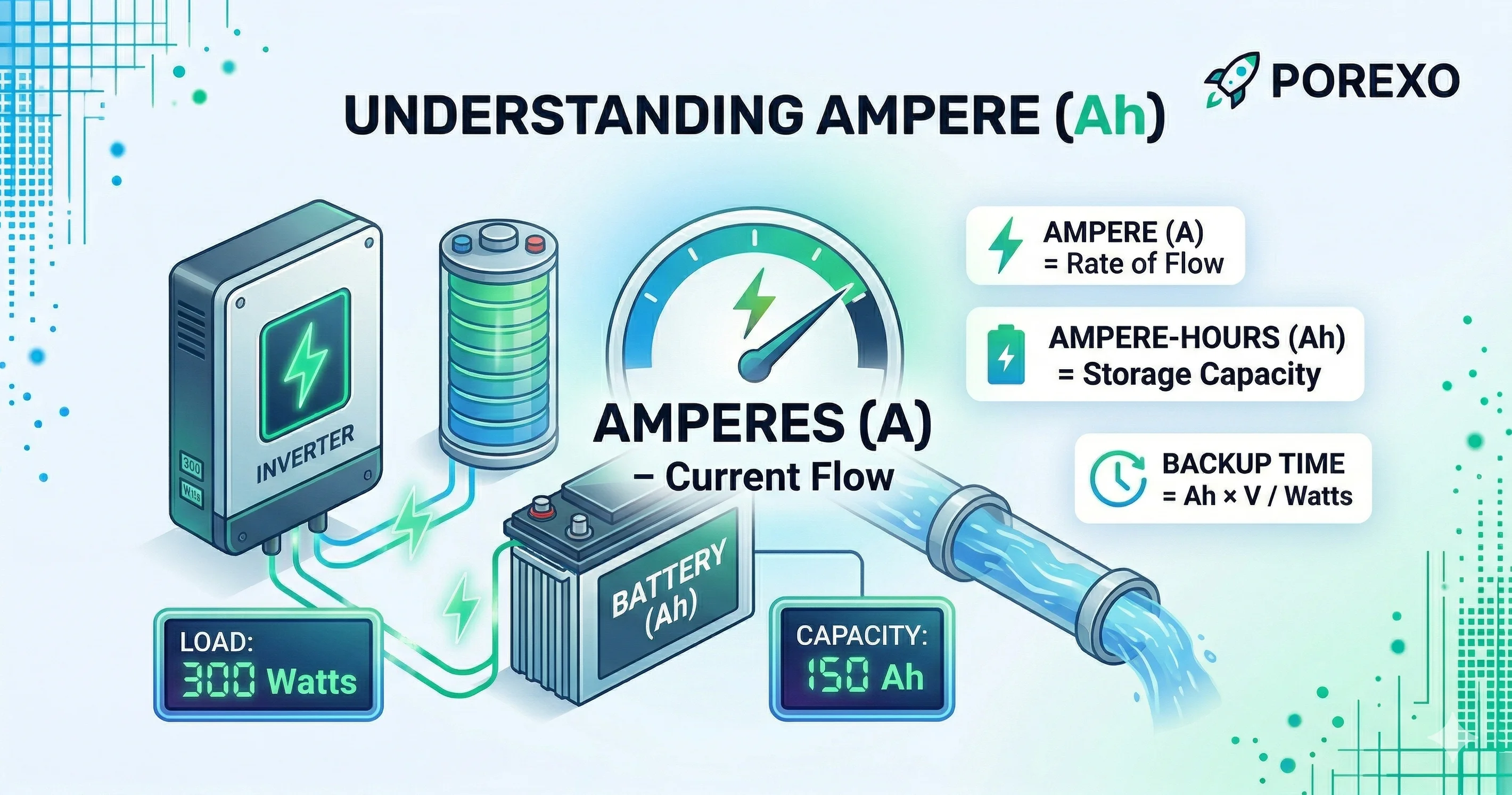
Think of electricity like water flowing through a pipe. The Ampere (often shortened to "Amp" or "A") is simply the measure of how much of that electrical "water" is flowing at any given moment. It's the unit for electric current.
Handy Tools For You
More Amps means more electrical flow, which can power bigger appliances—just like a wider pipe can deliver more water to fill a bucket faster.
Ampere in Batteries: It's About Stamina
When you look at a battery, you'll often see a rating like "100Ah." The "Ah" stands for Ampere-hour. This tells you about the battery's capacity, or its "stamina."
- Simple Analogy: If a battery is rated at 100Ah, it means it can theoretically supply 10 Amps of current for 10 hours (10A x 10h = 100Ah) before it's fully drained. It could also supply 5 Amps for 20 hours.
- What it means for you: A higher Ah rating generally means your battery will last longer between charges. If you need to run a few fans and lights for a long time during a power cut, you'll want a battery with a higher Ah number.
Ampere in Inverters: It's About Power Delivery
The inverter's job is to convert the DC power from your battery into the AC power that your home appliances use. Its Ampere rating tells you how much current it can safely deliver to your devices.
- Why it matters: Every appliance you plug in (like a TV, fridge, or mixer) draws a certain number of Amps. If the total Amps drawn by all your running appliances exceeds the inverter's rating, it will overload and likely shut down to protect itself.
- How to check: You can calculate the total Amps your appliances need. A simple formula is: Amps = Watts / Volts. For example, a 100-watt bulb on a 230V supply draws about 0.43 Amps (100W / 230V).
// Example: Calculating total load for an inverter
// Appliance Watts: Fridge (150W), 2 Fans (75W each), 5 Lights (20W each)
let fridgeWatts = 150;
let fanWatts = 75 * 2; // 150W total for two fans
let lightWatts = 20 * 5; // 100W total for five lights

let totalWatts = fridgeWatts + fanWatts + lightWatts; // = 400 Watts
let systemVoltage = 230; // Standard home voltage in many regions

let totalAmps = totalWatts / systemVoltage; // 400 / 230
console.log(`Total Ampere draw: ${totalAmps.toFixed(2)} A`);
// Output: Total Ampere draw: 1.74 A
// Your inverter should have a continuous rating higher than this.
Putting It Together: Battery and Inverter as a Team
Your battery (Ah) and inverter (A) need to work together. A massive battery with a high Ah can store a lot of energy, but if your inverter has a low Amp rating, it won't be able to deliver that energy fast enough to run your heavier appliances. Conversely, a powerful inverter paired with a small battery will drain the battery very quickly.
The key is balance. Match the inverter's Amp rating to the total load you plan to run, and match the battery's Ah rating to how long you need to run that load.
Quick Tips for Choosing
- List your essentials: Write down the wattage of the appliances you must run during a power cut (e.g., lights, fan, modem, one TV).
- Calculate total Watts and Amps: Use the formula above to find the total Amps you need.
- Pick an inverter: Choose an inverter with a continuous Amp rating that is 20-25% higher than your calculated need. This gives you a safety buffer.
- Pick a battery: Choose a battery with an Ah rating that will last for your required backup time. A dealer can help you calculate this based on your inverter's power draw.
For more help with electrical calculations, you can check out our Unit Converter tool to easily convert between different measurements.
Frequently Asked Questions
📚 Read Next
Is a higher Ah battery always better?
Not always. A higher Ah battery is physically bigger, heavier, and more expensive. It's better only if you need longer backup time. For short power cuts, a moderately sized battery is more cost-effective and easier to manage.
Can I connect a high Ah battery to a small inverter?
Yes, you can physically connect them. The battery will just last a very long time because the small inverter can only draw a limited amount of current from it. The main limitation is that the inverter won't be able to power heavy appliances because of its own low Amp rating, regardless of the battery size.
What happens if I exceed my inverter's Amp rating?
Most modern inverters have overload protection. They will simply beep and shut off to prevent damage. You'll need to turn off some appliances and restart the inverter. Consistently overloading it can damage the inverter over time.
How is Ampere (A) different from Voltage (V)?
Using the water pipe analogy: Voltage (V) is like the water pressure that pushes the flow. Ampere (A) is the amount of water flowing. You need both the right pressure (Volts) and the right flow (Amps) for your appliances to work correctly. You can learn more about these basic concepts through resources like Explain That Stuff's electricity guide.