Thinking about making your home a bit smarter? The ESP32 is a fantastic little chip that can connect to Wi-Fi, making it perfect for home automation projects. It's like giving your regular home devices a brain and an internet connection. Let's look at some practical projects you can build, complete with code to get you started.
Project Ideas You Can Build
Here are a few straightforward projects to turn your house into a smarter home:
Handy Tools For You
- Remote Control for Lights & Plugs: Turn your lights or fan on and off from your phone, no matter where you are.
- Smart Doorbell with Alerts: Get a notification on your phone with a picture when someone rings your bell.
- Room Climate Monitor: Keep an eye on the temperature and humidity in different rooms from a simple dashboard.
- Automatic Garden Watering: Build a system that waters your plants based on soil moisture, so you never over or under-water.
- Voice-Controlled Devices: Connect your projects to Alexa or Google Assistant so you can control things just by talking.
Getting Started: A Basic Light Control Example
Let's write a simple program to control an LED (which represents a light) over Wi-Fi using a web page. This is the "Hello World" of home automation.
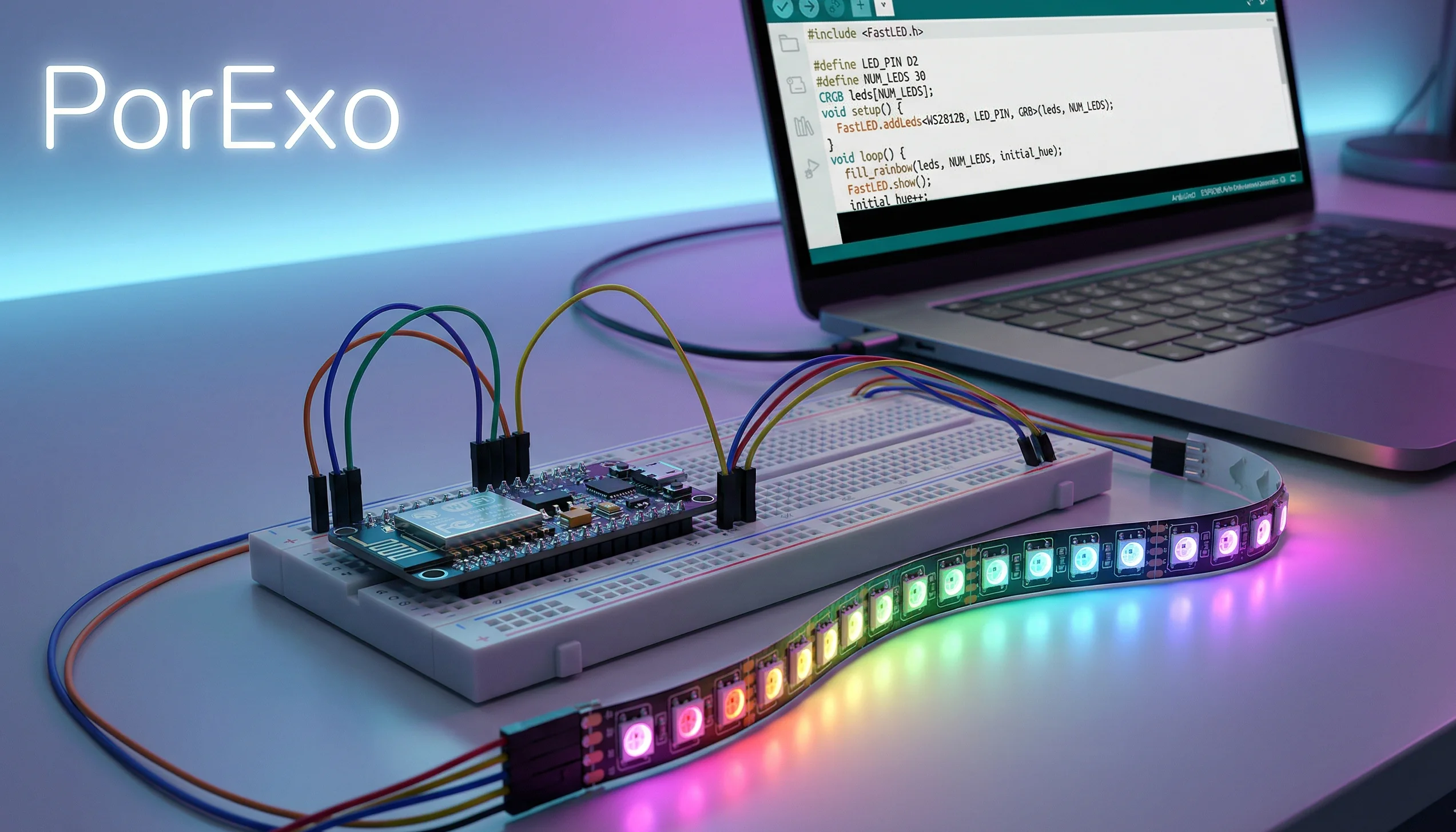
First, you'll need to install the ESP32 board in your Arduino IDE. Then, connect an LED to pin GPIO2 on your ESP32 (don't forget a resistor!).
Here's the code that sets up a web server. When you go to the ESP32's IP address in your browser, you'll see buttons to turn the LED on and off.
#include
// Replace with your Wi-Fi details
const char* ssid = "Your_WiFi_Name";
const char* password = "Your_WiFi_Password";
WiFiServer server(80); // Set up a server on port 80 (the standard web port)
const int ledPin = 2; // The pin where your LED is connected
void setup() {
Serial.begin(115200);
pinMode(ledPin, OUTPUT);
digitalWrite(ledPin, LOW);
// Connect to Wi-Fi
Serial.print("Connecting to ");
Serial.println(ssid);
WiFi.begin(ssid, password);
while (WiFi.status() != WL_CONNECTED) {
delay(500);
Serial.print(".");
}
Serial.println("");
Serial.println("WiFi connected.");
Serial.println("IP address: ");
Serial.println(WiFi.localIP()); // This is the address you type in your browser
server.begin(); // Start the web server
}
void loop() {
WiFiClient client = server.available(); // Check if a client (browser) has connected
if (client) {
Serial.println("New Client.");
String currentLine = "";
while (client.connected()) {
if (client.available()) {
char c = client.read();
Serial.write(c);
if (c == '\n') {
// If the line is blank, the HTTP request has ended
if (currentLine.length() == 0) {
// Send the HTML page back to the client
client.println("HTTP/1.1 200 OK");
client.println("Content-type:text/html");
client.println();
// The HTML for the web page with buttons
client.print("Click to turn the LED on.
");
client.print("Click to turn the LED off.
");
client.println();
break;
} else {
currentLine = "";
}
} else if (c != '\r') {
currentLine += c;
}
// Check what the client requested
if (currentLine.endsWith("GET /H")) {
digitalWrite(ledPin, HIGH); // Turn LED ON
}
if (currentLine.endsWith("GET /L")) {
digitalWrite(ledPin, LOW); // Turn LED OFF
}
}
}
client.stop();
Serial.println("Client Disconnected.");
}
} After uploading this code, open the Serial Monitor. It will show you the IP address (like 192.168.1.100). Type that address into your phone or computer's web browser, and you'll see your control buttons!
Where to Go From Here
This basic example opens the door to much more. You can replace the LED with a relay module to control actual AC appliances safely. For more advanced and user-friendly interfaces, you can use platforms like Home Assistant or Blynk.
If you need to work with other file formats for configuration or data logging, check out our CSV Editor and JSON Editor tools to help manage your project data.
Frequently Asked Questions
📚 Read Next
Is the ESP32 safe for controlling home appliances?
Yes, but you must be careful. The ESP32 itself works with low voltage (3.3V). To control high-voltage devices like lights or fans, you must use a relay module as a switch. Never connect mains AC voltage directly to the ESP32 pins.
Do I need to be an expert programmer to start?
Not at all! Many projects have ready-to-use code examples online. Starting with the basic LED control (like above) is a great way to learn. The community is very supportive, so you can find help easily.
Can I control my projects when I'm not at home?
Yes, but it requires a bit more setup. You can use a service like Blynk or set up port forwarding on your router (with proper security). A simpler and safer method for beginners is to use a cloud-based IoT platform that handles the remote connection for you.
What's the difference between ESP32 and Arduino?
Arduino is a brand and a software platform. An ESP32 is a specific chip with built-in Wi-Fi and Bluetooth. You can program the ESP32 using the familiar Arduino software (the IDE), which makes it very accessible if you're already used to Arduino.