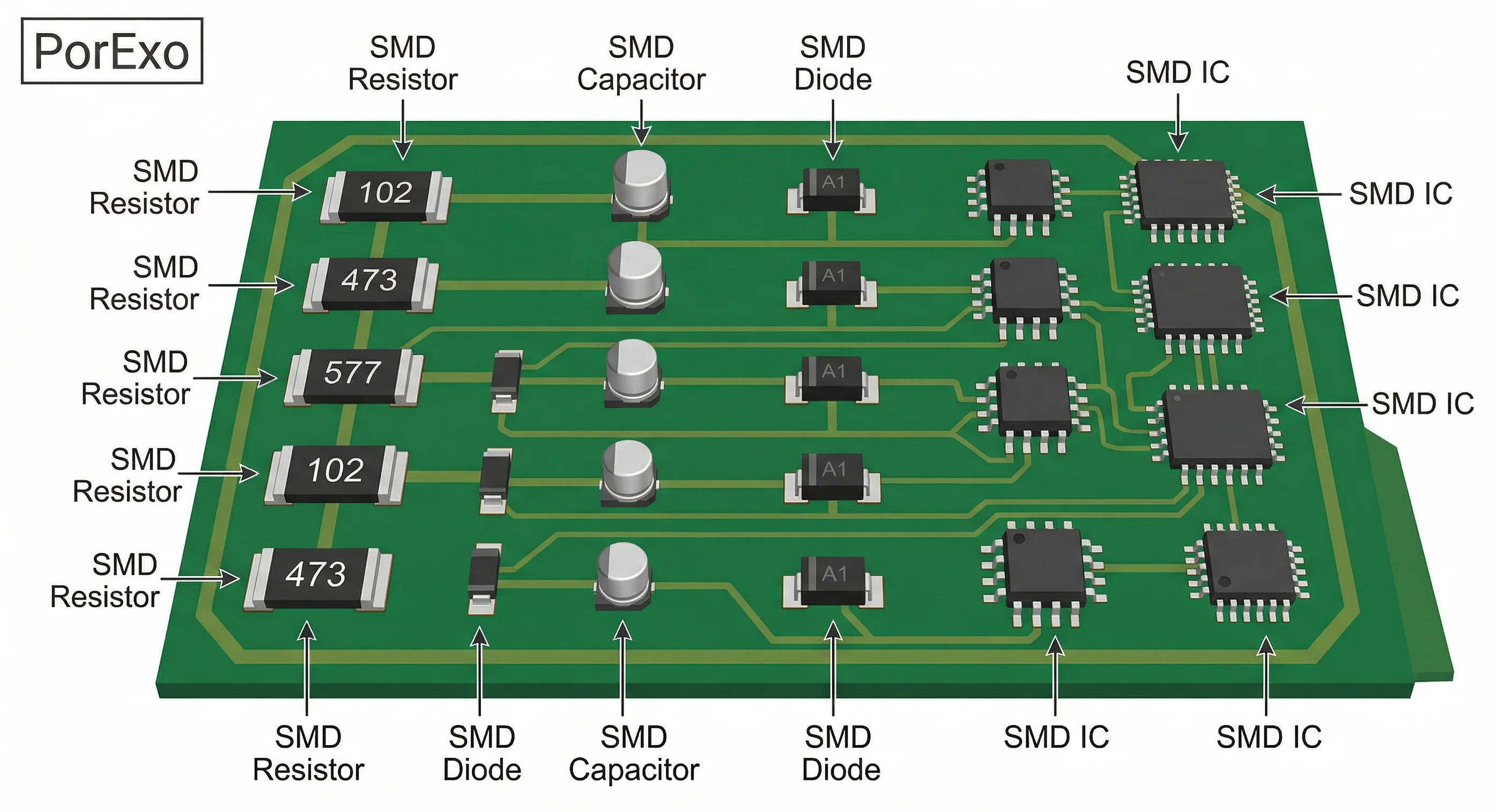
Let's talk about SMD components. If you're new to electronics, you might have seen those tiny, flat parts on a circuit board without any long wires. Those are SMDs, which stands for Surface Mount Device. They are soldered directly onto the surface of the board, which is why modern gadgets like your phone or laptop can be so slim and compact.
Understanding the different types is useful, whether you're just curious, learning to repair things, or starting your own projects. Here’s a simple breakdown of the main kinds you'll come across.
Handy Tools For You
Common Types of SMD Components
Each type of component has a specific job in a circuit. Here are the key players:
1. Resistors
Think of a resistor as a tiny traffic controller for electricity. It limits the flow of current to protect other parts. SMD resistors are incredibly small, often just a little rectangle with numbers printed on them. Despite their size, they can handle a surprising amount of power. They come in standard packages like 0402, 0603, or 0805, where the numbers refer to their length and width in hundredths of an inch.
2. Capacitors
A capacitor is like a small rechargeable battery that stores and releases electrical energy quickly. In an SMD form, they help smooth out power supply fluctuations and are crucial for timing circuits. Just like resistors, they save a ton of space. You can't always tell what they do by looking, as most are just plain, tiny, colored blocks.
3. Diodes
A diode is a one-way street for electricity. It lets current flow in only one direction, which is perfect for converting AC to DC power. SMD diodes are great for high-frequency applications (like in radio circuits) because they can switch on and off very fast. They often have a small line or mark on one end to show the direction of the current.
4. Transistors
Transistors are the amplifiers and switches of the electronics world. They can turn a small electrical signal into a larger one, or act like a tiny, precise on/off switch. SMD transistors pack this functionality into a speck-sized package, making circuits more efficient and powerful without taking up much room.
5. Integrated Circuits (ICs)
This is where things get clever. An Integrated Circuit, or IC, is a whole mini-circuit—containing thousands or even millions of transistors, resistors, and other parts—all squeezed onto a single, flat chip. Your computer's processor is a super advanced IC. In SMD form, these chips have little metal legs or pads on their sides or underneath for soldering. They are the brains behind complex operations.
Why Use SMD Components?
You might wonder why everyone uses these tiny parts now. Here are a few good reasons:
- Small Size: They allow for much smaller and lighter devices.
- Better for High Frequencies: Their short leads mean less interference, which is vital for modern, fast electronics.
- Easier for Machines: They are perfectly designed to be placed and soldered by automated machines, speeding up manufacturing.
- More Reliable: With no wires to bend or break, they can be more durable on a board.
If you're looking to work with these components, you might need some specific tools. For example, a good Image to Text tool can help you read codes from blurry component photos, and a Unit Converter is handy for translating between different package sizes.
Frequently Asked Questions
📚 Read Next
What does SMD stand for?
SMD stands for Surface Mount Device. It refers to electronic components that are designed to be mounted directly onto the surface of a printed circuit board (PCB), unlike traditional components with long wire leads that go through holes in the board.
Are SMD components better than through-hole components?
"Better" depends on the application. SMD components are superior for modern, compact, and high-speed devices like smartphones. Through-hole components are often easier for beginners to hand-solder and can be more physically robust for some prototypes or high-power applications. Most modern design uses a mix of both.
How can I identify an SMD component?
It can be tricky! Many have a tiny code printed on them. You can use a magnifying glass or microscope to read the code and then look it up in a manufacturer's datasheet or an online SMD code database. The size and shape of the package (like 0603 or SOT-23) also give clues about what type of component it is.
Can I solder SMD components at home?
Yes, you can, but it requires some practice and the right tools. A fine-tip soldering iron, good quality solder, flux, and tweezers are essential. For very small parts, many hobbyists use a hot air rework station or even a "solder paste and hot plate" method. There are great tutorials online to get you started.
Where can I learn more about electronics components?
A fantastic free resource to learn the basics is the Electrical Engineering section on Khan Academy. For a more hands-on, community-driven approach, websites like SparkFun Tutorials are excellent.