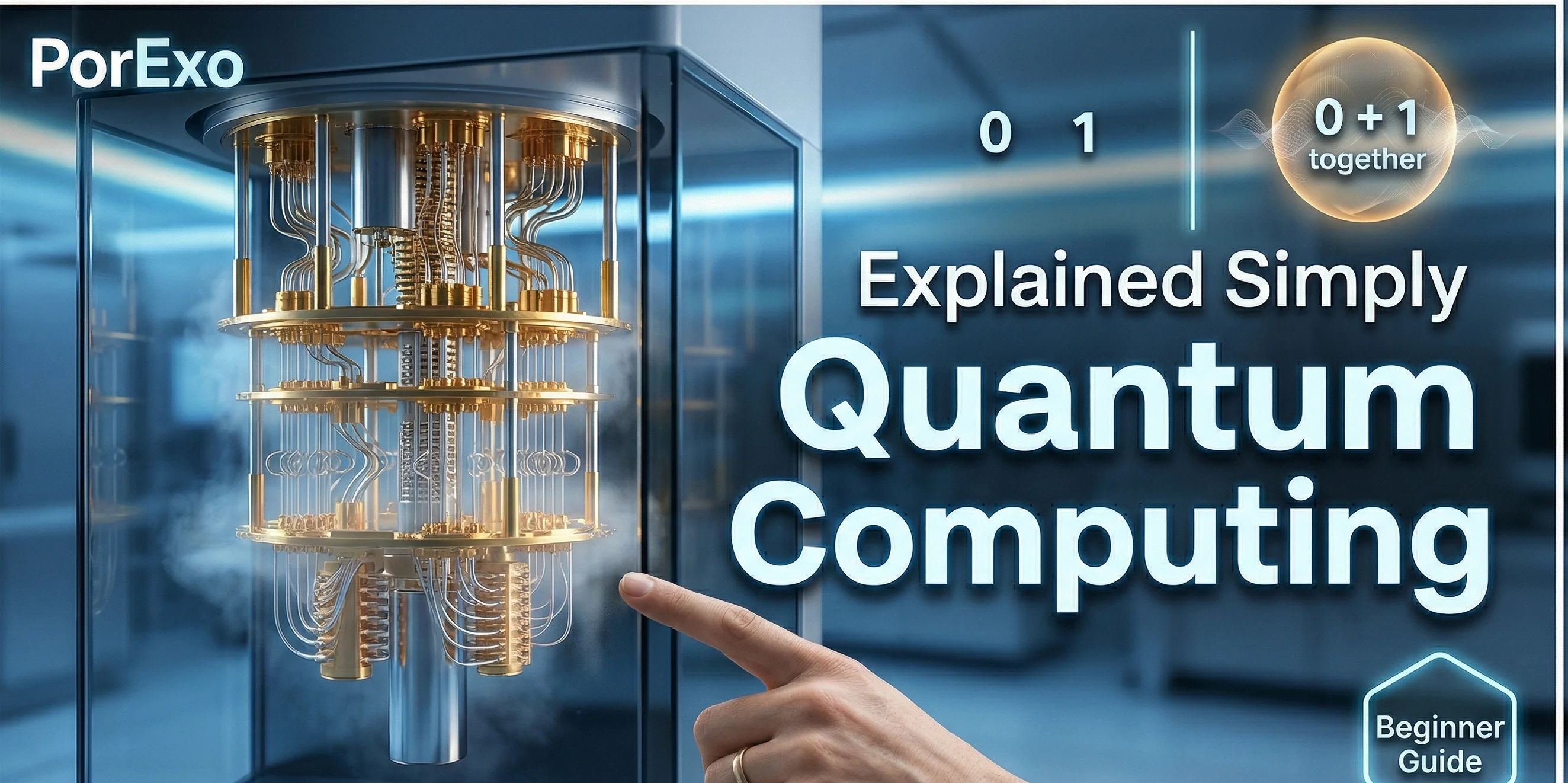
Let's talk about quantum computing. If you're new to this, don't worry—it's a fascinating idea that's simpler than it sounds. Think of it as a completely different way for a computer to think, using the rules of the very tiny world of atoms and particles.
Your regular computer, like your phone or laptop, works with bits. A bit is like a tiny light switch that can only be either ON (1) or OFF (0). Every piece of data, from a text message to a video, is built from millions of these simple on/off switches.
A quantum computer uses something called a qubit (quantum bit). Here's the mind-bending part: because of quantum physics, a qubit doesn't have to be just a 0 or a 1. It can be both at the same time. This special ability is called superposition.
It's like a spinning coin. While it's in the air, it's not just heads or tails—it's in a fuzzy state of being both. A qubit works in a similar, probabilistic way.
Why is this a big deal?
Let's say you have two bits. They can represent four possible states (00, 01, 10, 11), but they can only be one of those at a time. Two qubits in superposition can represent all four of those states simultaneously. As you add more qubits, this ability grows exponentially. This lets a quantum computer explore a massive number of possibilities all at once, which is why it could solve certain complex problems much, much faster.
Another weird trick: Entanglement
This is another quantum phenomenon that quantum computers use. If two qubits become "entangled," what happens to one instantly affects the other, no matter how far apart they are. This creates a powerful link that helps qubits work together in complex calculations.
What could it be used for?
- Creating new materials and medicines: Simulating how molecules interact is incredibly hard for today's computers. Quantum computers could model these interactions to help discover new drugs or super-efficient batteries.
- Optimizing complex systems: Figuring out the most efficient routes for a global shipping network or managing financial risk in markets.
- Cryptography: It could break some of today's encryption methods, but it could also help create new, ultra-secure forms of encryption. For managing sensitive documents, using tools like a PDF password protector is a good current practice for security.
It's important to know that quantum computers aren't just "faster" versions of your laptop. They won't run your web browser or edit photos better. They are specialized tools designed to crack very specific, incredibly complex problems that are practically impossible for classical computers.
# A very simple conceptual example (not real quantum code!)
# Classical bit: Can be 0 OR 1
classical_bit = 0

# Qubit (conceptually): Can be in a state that is a *probability* of being 0 or 1.
# This is often represented as a vector.
import numpy as np
# A qubit state vector: [probability amplitude for 0, probability amplitude for 1]
qubit_state = np.array([0.707, 0.707])  # Represents a 50/50 chance of measuring 0 or 1
print("Qubit state vector:", qubit_state)
print("This qubit is in a superposition of 0 and 1.")
For a great external resource to visualize and play with these concepts, check out IBM's Quantum Composer. It's a fantastic way to see qubits and circuits in action.
Frequently Asked Questions
📚 Read Next


Can I buy a quantum computer for my home?
Not anytime soon. Today's quantum computers are massive, fragile machines that need to be kept at temperatures colder than outer space to work. They are primarily accessed via the cloud by researchers and companies.
Will quantum computers make my computer or phone obsolete?
No. Classical computers are excellent at everyday tasks—sending emails, playing games, browsing the web. Quantum computers will likely work alongside them, handling the specific heavy-duty problems they're good at, much like a supercomputer does today.
How far away are practical quantum computers?
We have working quantum computers now, but they are still in the early "experimental" phase. The biggest challenge is managing "noise" and errors in the qubits. Most experts believe it will be at least 5-10 years before we see them solving major real-world problems reliably. For now, you can rely on powerful classical tools for your tasks, like our suite of online tools for developers and creators.